

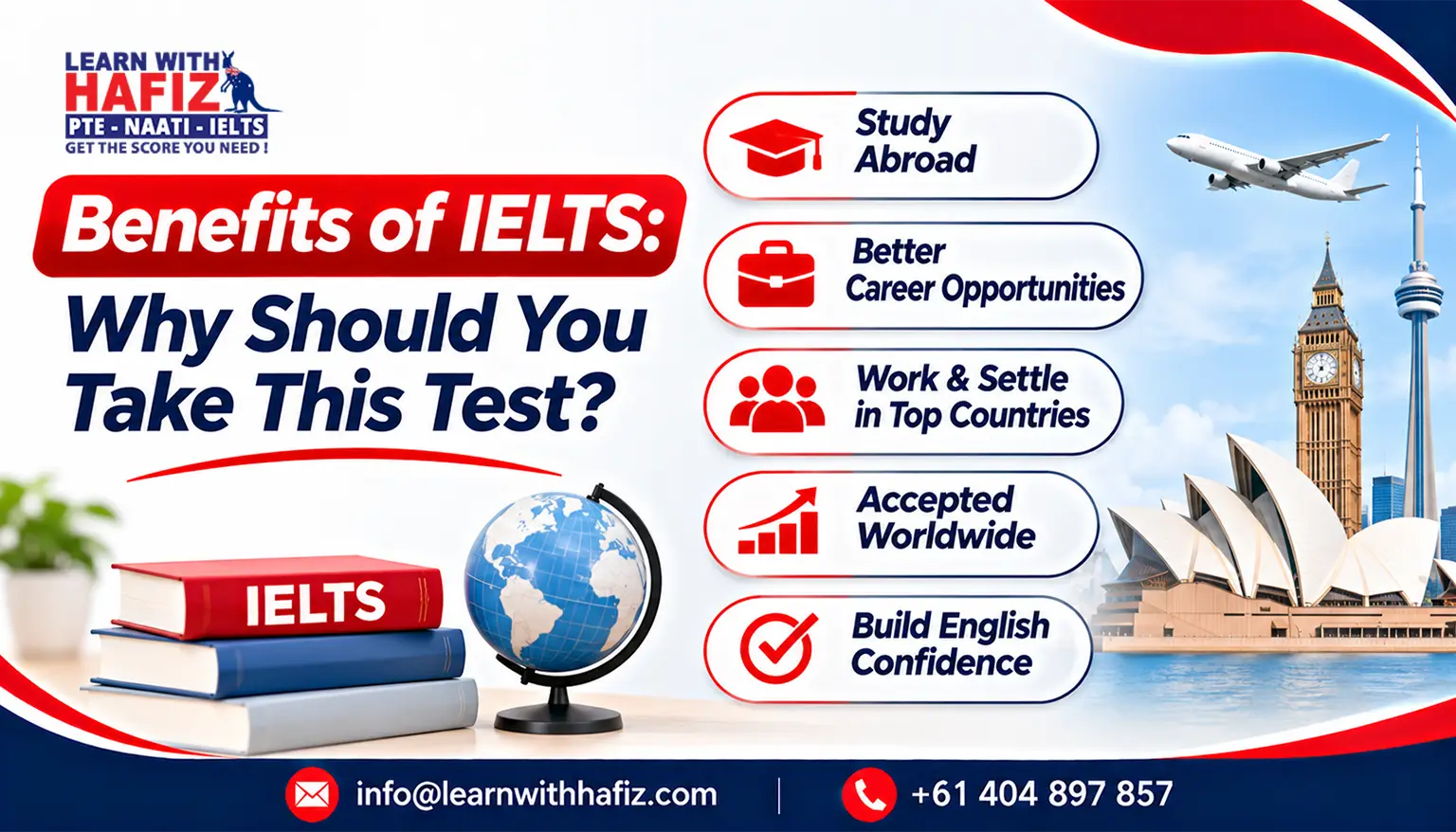
Many people know they need an English test for study, work or migration, but they aren’t sure which one to take. Others wonder whether the time and money spent on IELTS will actually pay off.
That decision matters. The wrong test, or the wrong version, can delay a visa or university application by months.
This guide explains the real benefits of IELTS, who it suits and where it’s accepted. It also compares IELTS with other tests honestly, so you can choose with confidence rather than guesswork.
Knowing why you’re taking a test makes preparing for it much easier. If you’d like help working out which IELTS version and score you need, you can Book a Free Trial Class with Learn with Hafiz and talk it through with a trainer.
Benefits of IELTS Test
IELTS stands for the International English Language Testing System. It’s jointly owned by the British Council, IDP and Cambridge University Press & Assessment.
Here are the main advantages of taking IELTS exam, based on how the test works today.
1. It Assesses Your Language Proficiency Fairly
IELTS gives you a separate score for Listening, Reading, Writing and Speaking. Many students look for a four skills assessment listening reading writing speaking test, and that’s exactly what IELTS offers.
Each skill gets a band score from 1 to 9, and your overall band is the average of the four. Therefore, organisations can see your strengths and weaknesses, not just one total number.
For example, scores of 6.5, 7.0, 6.0 and 7.0 average out to 6.625. That rounds to an overall band of 6.5, but each organisation can still look at your lowest skill.
The Speaking test is a live conversation with a trained examiner, not a computer. Depending on the test centre, it takes place in person or through a video call, and some students find that more natural than talking to a machine.
2. Worldwide Acceptance
IELTS is accepted by more than 13,500 organisations in over 140 countries, including universities, employers, professional bodies and government departments. IELTS has also been running for more than 35 years, so admissions and visa officers know it well.
That’s why many people see it as a trusted English test universities worldwide accept. In practice, IELTS opens doors to global opportunities because one result can support several applications at once.
For example, imagine a nurse planning to apply to hospitals in both Australia and the UK. A single valid IELTS result may help with both, as long as it meets each organisation’s score rules.
3. Improves Your English Language
IELTS preparation improves language skills you’ll use every day. You practise reading articles, writing clear arguments, following conversations and speaking with confidence.
Because the test covers all four skills, you can’t ignore your weak areas. With consistent practice, effective feedback and exposure to real-world English, IELTS preparation can help improve your communication skills and confidence, beyond simply preparing you for an examination.
That confidence matters after you arrive. You’ll use the same skills in lectures, job interviews, workplace meetings and everyday life.
For instance, practising IELTS Writing Task 2 teaches you to plan an argument and support it with examples. That’s the same skill you’ll need for university essays and workplace reports.
4. Greater Career Opportunities
IELTS career and employment benefits are real, especially in English-speaking countries. Your score acts as a benchmark English ability for employers to compare fairly, because the test is standardised and widely known.
Additionally, an IELTS credential boosts job application strength when a role requires clear communication. That includes jobs in healthcare, education, engineering and customer service.
Professional registration is another area. Many regulators, such as nursing, medical and teaching bodies, set their own score rules. So always check the professional body recognition IELTS score requirements for your field before you book.
Why Should You Take the IELTS?
The right reason depends on your goal. IELTS has two versions, and choosing correctly is one of the most important steps.
- IELTS Academic is for university study and many professional registration bodies.
- IELTS General Training is for work, training below degree level and migration to some countries.
Both versions use the same Listening and Speaking tests. However, Reading and Writing differ, so make sure you book the version your organisation asks for.
Choosing Between Academic and General Training
The quickest way to decide is to ask the organisation receiving your result. Universities usually want Academic, while migration programs often accept General Training.
Here are some typical situations, though your own requirements may differ.
- Applying for a bachelor’s or master’s degree. You’ll usually need IELTS Academic.
- Registering as a nurse or doctor overseas. Many regulators ask for Academic, so check your board’s rules.
- Applying for Canada’s Express Entry. You’ll need General Training.
- Applying for Australian skilled migration. Both versions are accepted for the points test.
If you book the wrong version, you’ll usually have to sit the test again. So confirm this before you pay.
1. IELTS for Study
IELTS Academic for higher education abroad is the most common choice for students. Universities in Australia, the UK, Canada, New Zealand and many other countries accept it.
There are clear IELTS benefits for students. Your score shows the university you can handle lectures, readings and assignments in English. Many universities also ask for a minimum score in each skill.
Many entry requirements fall within the IELTS band score 6 to 9 range. For example, a course might ask for 6.5 overall with no skill below 6.0, although every university sets its own rules.
Once you have your result, you can have your IELTS score report sent to institutions you choose. That lets them check your result directly, which can save time during admissions.
Why Do Students Choose IELTS?
Students choose IELTS because it’s widely accepted and familiar to admissions teams. It also gives you a clear target, which helps you plan your preparation.
Here’s a hypothetical example. Sara wants a master’s degree in Australia. Her university asks for IELTS Academic 6.5 overall, so she builds a three-month study plan around that number.
Preparing for a specific score is far easier with a clear plan and regular feedback. If you’d like a practical study plan built around your target band, you can Try a Free IELTS Lesson with Learn with Hafiz and see where you stand today.
2. IELTS for Work
Many employers and work visa routes ask for proof of English. General Training IELTS for work visa applications is common, although some routes accept Academic too.
For example, the UK generally asks new Skilled Worker applicants for B2 English. In IELTS for UKVI, that means at least 5.5 in each skill. Some people who held a Skilled Worker visa before 8 January 2026 can still meet B1 when extending or updating their visa, under transitional rules.
A good score can also help you stand out in a competitive job market. It shows employers you can communicate clearly from day one.
Here’s a hypothetical example. Omar applies for an engineering role overseas alongside several candidates with similar experience. His IELTS result gives the employer independent proof of his English, which removes one doubt from his application.
However, IELTS doesn’t replace qualifications or experience. Think of it as one strong piece of evidence that supports the rest of your application.
3. IELTS for Immigration
IELTS for permanent residency abroad is one of the biggest reasons people take the test. Australia, Canada, New Zealand and the UK all accept IELTS for various visa routes, though each has its own rules.
Australia uses IELTS for its points-tested skilled visas. This makes IELTS for skilled migration program applications especially important, because a higher score earns more points.
Here’s how PR points through IELTS score work in Australia’s points test.
- Competent English. At least 6 in each skill, which earns 0 points.
- Proficient English. At least 7 in each skill, which earns 10 points.
- Superior English. At least 8 in each skill, which earns 20 points.
So moving from Competent to Superior English can add 20 points to your application. In a competitive pool, those extra points can make a real difference.
Canada accepts IELTS General Training for its Express Entry programs. However, IELTS Academic is not accepted for Express Entry, so choose the version carefully.
The UK requires an approved Secure English Language Test (SELT) for many visa routes. IELTS for UKVI is one approved option, alongside tests from other approved providers. However, standard IELTS isn’t accepted where a route specifically asks for a SELT.
New Zealand also accepts IELTS for many visa categories, with score requirements that vary by visa type.
Rules change often, so always check the official government website for your route before you book.
IELTS vs Other English Proficiency Tests
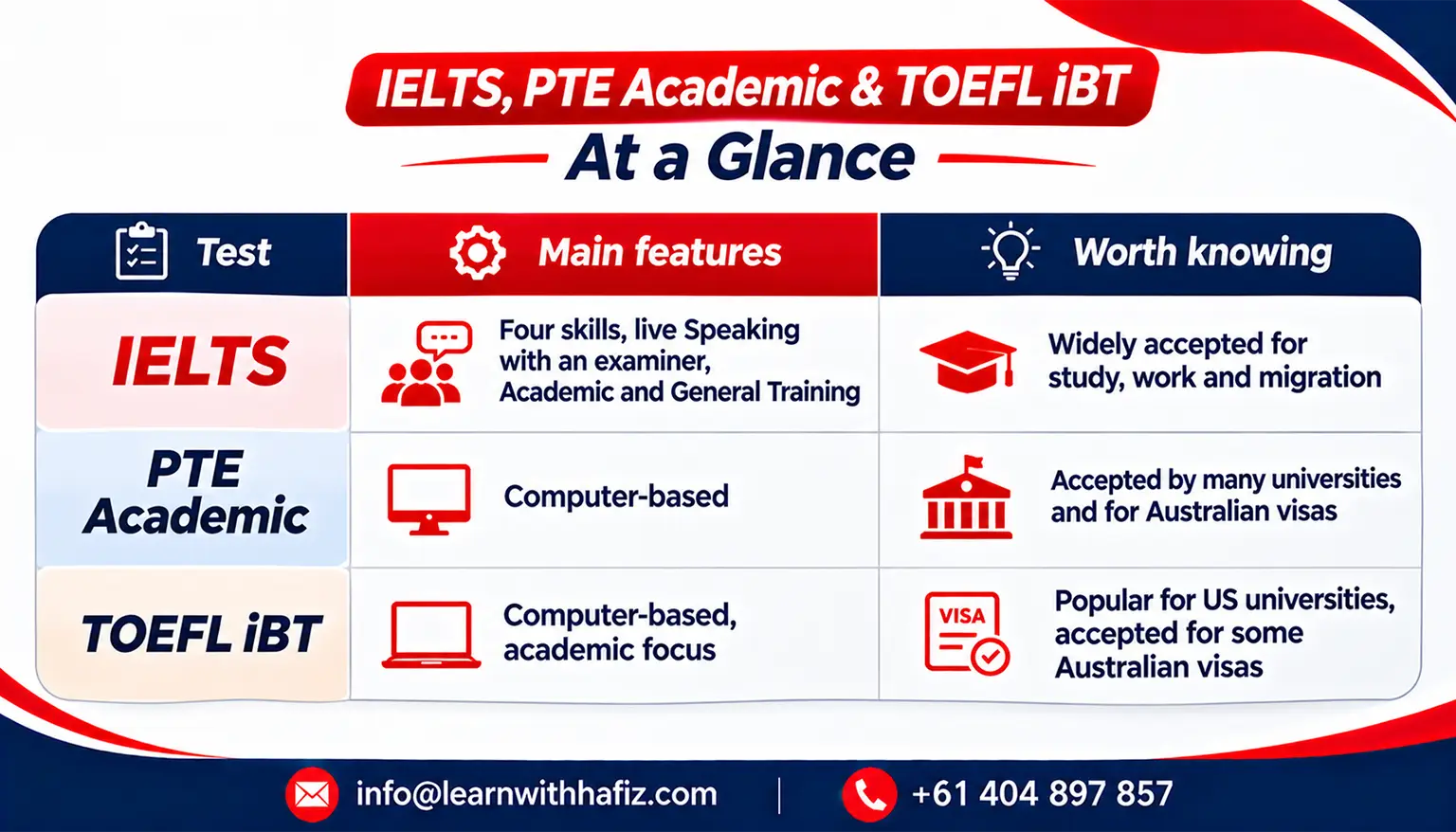
IELTS isn’t the only option. Comparing IELTS vs other English proficiency tests helps you pick the right one for your goals.
Is IELTS Better Than TOEFL?
Many students search for why IELTS is better than TOEFL. The honest answer is that neither test is better for everyone. It depends on where you’re going and what you need the result for.
IELTS has some practical advantages. IELTS General Training is accepted for Canada’s Express Entry, while UK visa routes that require a SELT accept IELTS for UKVI. TOEFL iBT, by contrast, isn’t on the UK’s approved SELT list and isn’t accepted for Express Entry.
However, TOEFL is very common for US universities and is accepted for some Australian visas. For Australia, you need to register through the Australia-specific TOEFL option, so check the booking rules carefully. And if you’re heading to a US university, TOEFL may suit you just as well.
When Another Test Might Suit You Better
IELTS isn’t always the only or best choice. For example, some students prefer PTE Academic because every part, including Speaking, is computer-based.
Canada’s Express Entry programs accept IELTS General Training, CELPIP-General and PTE Core. So if you’re only applying to Canada, compare those options too.
The best test is the one your organisation accepts and that suits how you perform under exam conditions. If you’re unsure, try a practice test in each format before deciding.
What’s New with IELTS in 2026
IELTS has changed recently, so it’s worth knowing the current format before you book. From mid-2026, IELTS is no longer offered as a fully paper-based test. The exact switchover date varied by country, so check with your local test centre.
Listening and Reading are now taken on computer. However, the Speaking test is still a live conversation with a real examiner, either in person or by video call depending on the centre. In selected countries, people taking standard IELTS Academic or General Training can also choose a Writing on Paper option. However, this option isn’t available for IELTS for UKVI.
IELTS One Skill Retake is another useful option. It lets you resit one skill within 60 days of your original IELTS on computer test, at participating centres. Not every organisation accepts it, though. For example, Canada’s Express Entry doesn’t accept One Skill Retake results.
How to Get the Most Out of IELTS
The benefits only matter if you reach the score you need. These steps help you prepare with purpose.
- Confirm your target. Check the exact version and score each organisation needs, including per-skill minimums.
- Take a practice test. Find your current level in all four skills before you start studying.
- Focus on weak skills. Because many organisations set per-skill minimums, one weak skill can hold you back.
- Get feedback on Writing and Speaking. These skills are hard to judge alone, so ask a teacher to review them.
- Sit timed mock tests. Practise on a computer, because Listening and Reading are now computer-based.
Plan your test date around your deadlines, too. Leave enough time for a retake or One Skill Retake if one score falls short.
Common Concerns about Taking IELTS
Is IELTS too difficult?
IELTS is challenging, but it isn’t designed to trick you. With the right preparation, many students improve steadily over time.
How long is my IELTS result valid?
IELTS recommends that organisations generally treat test results as evidence of English proficiency for a maximum of two years. However, immigration authorities may apply different validity rules. For example, Australia’s Department of Home Affairs accepts certain English test results taken within the previous three years for specific visa purposes. Always check the validity requirements of the organisation or visa authority you are applying to.
Is IELTS worth the cost?
For many people, yes, because one result can support study, work and migration plans together. Still, it’s only worth it if you book the version your organisation actually accepts.
How soon will I get my results?
IELTS results are generally available within 1–5 days for IELTS on computer, including IELTS for UKVI. IELTS for UKVI Life Skills results can take up to 9 days. IELTS Online results are generally available within 6–8 days. Actual result availability should be confirmed with your test provider.
Can I take IELTS more than once?
Yes. There’s no limit on how many times you can sit IELTS. However, it makes sense to prepare properly between attempts rather than rebooking straight away.
Is a higher score always better?
A higher score gives you more options, especially for Australian PR points. However, you only need to meet the score your organisation asks for, so set a realistic target first.
Can I take IELTS online?
IELTS Online is available for Academic purposes only. However, it is not accepted for immigration or professional registration purposes. Students should also check whether their chosen university accepts IELTS Online before booking. Visa and professional registration applicants should take an approved test at an authorised test centre.
Wrapping Up
The benefits of IELTS go well beyond a single score. It’s widely accepted, it tests all four skills fairly and it supports study, work and migration goals.
Many people describe the life changing benefits passing IELTS exam can bring, from a university place to permanent residency. Those results are possible, but they depend on choosing the right version and preparing properly.
So start by confirming your target score, then build a study plan around your weakest skill. Small, steady improvements in each skill add up to a better overall band.
With the right preparation and honest feedback, you can reach your target score with confidence. Book Your Free Trial Class with Learn with Hafiz today, or call +61 404 897 857 to plan your IELTS preparation around your goals.
FAQs
Who needs to take IELTS?
Anyone who needs to prove their English for study, work or migration in an English-speaking country may need IELTS. Your university, employer or visa route will tell you which version and score you need.
Which skills matter most in IELTS?
All four skills matter, because your overall band is the average of Listening, Reading, Writing and Speaking. Many organisations also set a minimum score for each skill.
Is IELTS good for students?
Yes. IELTS Academic is widely accepted by universities, and preparing for it builds the English skills you’ll need for study.
Is IELTS important for permanent residency?
For many routes, yes. For example, Australia’s points test gives up to 20 points for Superior English, which can make a big difference to your application.