

IELTS Writing can feel difficult, even when your English is strong. You may know plenty of vocabulary and grammar rules and still lose marks. Your answer might miss part of the question, your ideas might lack order, or small spelling errors might build up.
This guide explains the most common mistakes in IELTS writing and shows you how to fix each one. Whether you take Academic or General Training, you will find practical advice on grammar, vocabulary, essay organization, and time management. Learn With Hafiz created this guide to help you work towards IELTS writing score improvement in a clear and realistic way.
Ten Common IELTS Writing Mistakes
Knowing the typical errors is the first step towards clearer answers. Each mistake affects a different part of your performance, so your preparation must cover more than grammar. These ten problems are worth checking in your own writing, whether you see them as common student errors or personal habits.
Learn With Hafiz recommends a simple method. Practise under timed conditions, review your errors, and apply the corrections in your next attempt. This approach helps you identify and correct your own writing weaknesses.
1. Over-writing
Word count matters in IELTS Writing, so remember that in both Academic and General Training, Task 1 needs at least 150 words and Task 2 needs at least 250 words. If your answer is shorter than this, you will be penalised.
However, a longer answer does not earn a higher band automatically. Long responses can repeat ideas, include irrelevant details, and add extra grammar errors.
How to avoid this mistake
Meet the minimum word count and develop your ideas fully. Plan your main points before you write, and leave time to check your work, because a clear and relevant essay is better than a longer one full of repetition.
IELTS guidance suggests about 20 minutes for Task 1 and 40 minutes for Task 2. Task 2 carries twice the weight of Task 1, so plan your time with that in mind.
2. Not answering the question correctly
Misunderstanding the question is one of the most serious IELTS writing task mistakes. Candidates often recognise the topic, but they overlook what the instructions actually ask them to do.
Suppose a question asks you to discuss the advantages and disadvantages of working from home. If you describe only the advantages, your answer is incomplete, even with excellent grammar. Likewise, a question that asks whether you agree or disagree needs a clear position with relevant reasons. A general discussion of the topic will not satisfy it.
This problem links directly to task achievement, the criterion that measures how fully you meet the requirements of Task 1. In Task 2, the matching criterion is task response.
How to avoid this mistake
Decide whether you must discuss both views, explain causes and solutions, or justify your opinion. Then write down your position and your main points before you start, so your plan guides every paragraph.
3. Ignoring grammar mistakes
Grammar errors can make your meaning unclear and lower your grammar accuracy. Even candidates with strong vocabulary struggle when they repeatedly misuse verb tenses, articles, subject and verb agreement, or sentence structure.
Here is an example of one of the common grammar mistakes in IELTS writing.
Incorrect version. People is using public transport because it are cheaper.
Correct version. People are using public transport because it is cheaper.
However, you do not need to remove every small error to score well. Examiners assess grammatical range and accuracy together. They consider both the variety of structures you use and how correctly you use them.
How to avoid this mistake
List the grammar patterns you often get wrong. Practise simple, compound, and complex sentences in your own words, and after each essay, check agreement, tense, articles, prepositions, and punctuation errors.
4. Unfamiliarity with format
Knowing the format helps you prepare the right kind of answer. Academic and General Training share the same two-task structure, but Task 1 differs between them.
In Academic Task 1, you describe visual information such as graphs, charts, tables, diagrams, maps, or processes. In General Training Task 1, you write a letter for a specific purpose and reader. However, Task 2 is an essay in both versions, and you may need to give an opinion, discuss views, explain a problem, or evaluate solutions.
The total Writing time is 60 minutes. Write both responses in full, connected text. Do not write your answers as notes or bullet points.
How to avoid this mistake
You can use the official IELTS Writing preparation resources to become familiar with the format. Learn With Hafiz can also help you organise your practice around the task types you need most.
5. Spelling mistakes
Spelling errors may seem minor, but repeated IELTS writing spelling mistakes can affect your lexical resource score. Spelling precision matters because it helps you communicate your meaning clearly.
Examples include confusing their with there, writing enviroment instead of environment, and typing wich instead of which. Some candidates also carry texting habits into the exam. Informal texting abbreviations such as u, bcoz, and plz are a separate problem from ordinary misspellings, and they do not belong in a formal writing style.
How to avoid this mistake
Keep a personal list of words you often misspell, and practise them inside full sentences rather than as isolated items. Then, during proofreading, check plural endings, verb endings, double consonants, and commonly confused words.
6. Limited vocabulary
A wide vocabulary helps you express ideas precisely. However, using difficult words without knowing their meaning leads to vocabulary misuse, which makes a clear answer sound confusing or unnatural.
How to avoid this mistake
Learn vocabulary in context. Study collocations, which are words that commonly appear together, and use new expressions in your own sentences. Build your vocabulary around frequent IELTS topics such as education, health, technology, transport, and the environment.
7. Giving opinions without support
Personal opinions are not a mistake in IELTS Writing. The problem begins when you state an opinion and never explain it.
Consider this weak sentence.
Public transport is better than private cars because it is good.
The idea is too general. A stronger version gives a reason.
Public transport can reduce the number of private vehicles on busy roads, which helps ease congestion at peak hours.
How to avoid this mistake
Give each main argument a clear explanation and relevant support, for example by using a realistic example, a general observation, or a sensible comparison. You do not need to invent statistics or pretend that an example is a real study.
8. Using inappropriate language
Using inappropriate language can weaken an IELTS Writing response, even when your ideas are relevant. Slang, texting abbreviations, overly casual expressions, and vocabulary that does not fit the task can affect the clarity and appropriateness of your writing.
Academic Task 1 and Task 2 require a formal style. In General Training Task 1, however, the tone should match the purpose of the letter and the recipient, so informal language may be appropriate when you write to a friend.
How to avoid this mistake
Choose words and expressions that suit the task and audience. Avoid complicated vocabulary just to sound advanced, and check whether each expression communicates your meaning naturally. During proofreading, look for slang, vague wording, and expressions that sound too casual or too formal for the situation. These proofreading methods can improve your language accuracy without changing your intended meaning.
9. Failing to summarize the main features
In Academic Writing Task 1, candidates can lose focus when they describe individual figures but fail to summarise the main features. A response should identify the most important trends, differences, stages, or other characteristics shown in the visual information.
For example, if a chart shows that public transport use increased while car use declined, listing figures for every year without explaining these overall trends leaves the reader without a clear picture of the main findings.
How to avoid this mistake
Begin by identifying the most noticeable trends, comparisons, or features. Select information carefully instead of describing every data point, and check that you have not confused values, dates, units, or categories.
10. Inconsistent writing strategy
Inconsistent writing strategies can make an IELTS response harder to follow.
A familiar essay structure can help with organisation, but it should support the question rather than force every answer into the same pattern. Effective writing correction strategies focus on recurring weaknesses and help you apply improvements consistently.
How to avoid this mistake
Develop a reliable process for planning, writing, and reviewing your responses. Keep your position consistent, make sure each paragraph supports the task, and use linking expressions only when they show a genuine connection between ideas. Practise this process under timed conditions, then track recurring errors and use the same checking routine to improve your organisation, grammar, and proofreading methods over time.
Common Mistakes in IELTS Writing Task 1
The common mistakes in IELTS writing task 1 depend partly on your test type. Academic and General Training assess different kinds of writing, so you should practise the format you will take. Every IELTS writing task 1 response needs at least 150 words.
Academic Task 1 Mistakes
Academic writing mistakes in Task 1 usually involve poor selection of information. A frequent error is listing individual figures without identifying the main trends or comparisons.
Practical correction techniques
Begin with an introduction that paraphrases the task. Follow it with an overview of the key trends or features, and use later paragraphs to support the overview with comparisons and figures. Then check that your numbers, dates, units, and comparisons match the visual.
General Training Task 1 Mistakes
General Training Task 1 asks for a letter that responds to a situation. Candidates sometimes skip a bullet point or choose a tone that does not suit the reader.
Practical correction techniques
Identify the purpose of the letter and the reader before you write. Cover every required point, keep the tone appropriate, and organise the information logically. Choose a formal, semi-formal, or informal tone according to the purpose of the letter and your relationship with the recipient.
Common Mistakes in IELTS Writing Task 2
The common mistakes in IELTS writing task 2 often involve incomplete arguments, unclear positions, weak examples, and poor planning. Every IELTS writing task 2 essay needs at least 250 words, and it carries the greater weight.
One frequent problem is a memorised introduction that does not match the question. Another is listing several arguments without explaining any of them.
How to improve your Task 2 response
First, identify exactly what the question asks. Then choose two or three main ideas that you can explain well. Build each body paragraph around one argument, explain why it matters, and add a relevant example. Finally, make sure your conclusion reflects the position you presented.
Avoid writing templates that force your ideas into an unsuitable shape. A familiar framework can help your essay organization, but your answer must stay specific to the question.
Do Spelling Mistakes Matter in IELTS Writing?
Many candidates search for does spelling mistakes matter in IELTS writing. The grammatical form of the question is Do spelling mistakes matter in IELTS Writing? The answer is yes, because spelling forms part of the lexical resource criterion.
However, spelling mistakes in IELTS writing do not trigger a fixed deduction for each error. The examiner judges your overall performance against the official band descriptors. The effect of spelling and word formation errors depends on their frequency and impact on communication. Higher band descriptors generally expect more accurate and controlled vocabulary use.
Frequent spelling errors can lower your performance under the lexical resource criterion, particularly when they affect clarity or show limited control of vocabulary. This is not a fixed band score reduction for each mistake. Your goal should be better spelling precision alongside wider vocabulary and stronger grammar.
How IELTS Writing Is Assessed
Understanding the examiner criteria helps you focus on the skills that matter. IELTS examiners assess four criteria in each Writing task, and the criteria are equally weighted within each task.
Task achievement and task response
This criterion checks how accurately, appropriately, and relevantly your answer covers what the task asks. Task achievement applies to Task 1, and task response applies to Task 2.
Coherence and cohesion
This criterion looks at the logical order of your ideas and how well sentences and paragraphs connect.
Lexical resource
Lexical resource covers vocabulary range, accuracy, appropriateness, spelling, and word formation. Advanced vocabulary helps only when you use it correctly.
Grammatical range and accuracy
This criterion looks at the variety of structures you use and how accurately you use them, including punctuation.
Each criterion contributes to your result, and Task 2 carries twice as much weight as Task 1 in the overall Writing score. You can read the official IELTS Writing band descriptors to see what each band level looks like.
The British Council co-owns IELTS and publishes IELTS preparation guidance based on the same shared criteria. In this article, the phrase “British Council writing standards” refers to its IELTS preparation guidance, not a separate scoring system. This guidance provides a helpful additional reference. Focus on meeting the task, expressing ideas clearly, and using language accurately rather than collecting impressive words. These high-band writing strategies matter more than any single trick for score maximization.
A Practical IELTS Writing Score Improvement Roadmap
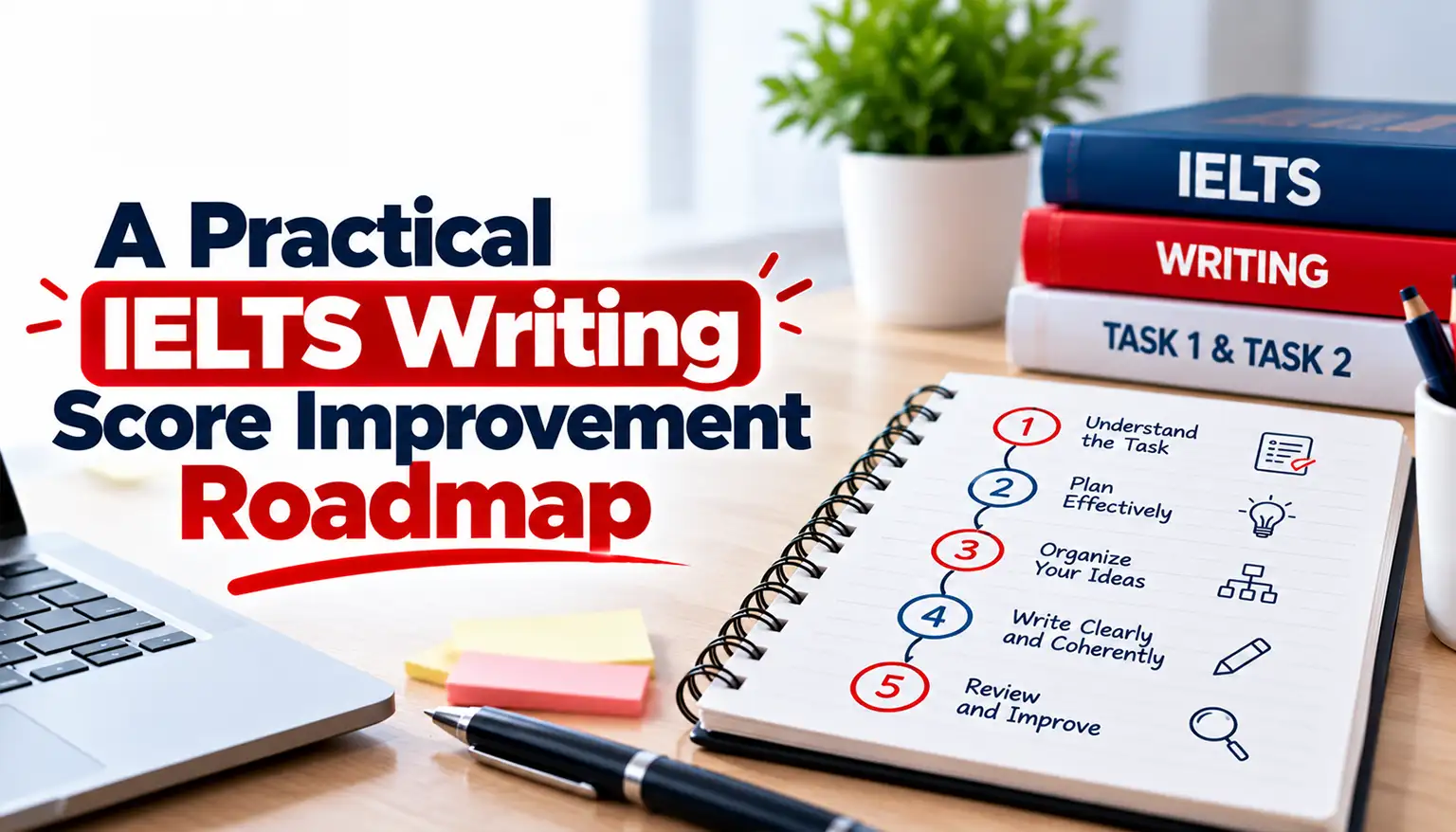
Improvement needs regular practice and a clear method for finding errors. This score improvement roadmap gives you five steps.
Step 1. Complete a timed writing practice
Write one Task 1 response and one Task 2 essay under real time limits, because this gives you a starting point for your strengths and weaknesses.
Step 2. Identify recurring mistakes
Review your answers and record the errors you make most often, then group them into grammar, spelling, vocabulary, task coverage, and organisation.
Step 3. Correct the underlying problem
Understand why the mistake happened and practise the rule or skill behind it. If your sentences often show agreement errors, practise that point with your own examples. Good writing correction strategies treat the cause, not the symptom.
Step 4. Rewrite selected paragraphs
Take one paragraph from your practice essay and improve its clarity, grammar, and organisation.
Step 5. Practise again and measure progress
Next, write another response under timed conditions and check whether the same mistakes appear less often and whether you now answer the question more fully.
This roadmap encourages steady progress rather than shortcuts. It also supports writing confidence building, because you can see which skills need attention and which are improving.
FAQs
Can I use writing templates in IELTS?
Yes, you can use a basic structure to organise your response. However, writing templates should support your ideas and never replace them. A memorised answer that ignores the question can weaken your task response or task achievement.
Should I use advanced vocabulary in every sentence?
No. Choose vocabulary that expresses your meaning accurately and naturally. Unnecessary complexity can cause vocabulary misuse and grammar errors. Precision, flexibility, and relevance matter more than difficult words.
How can I improve my grammar accuracy?
Identify the grammar mistakes you make most often and practise them in context. Review your corrections, then use timed practice to test whether you apply the rules consistently.
How can I get feedback on my IELTS essays?
Ask a qualified teacher or an experienced IELTS writing tutor to review your responses against the official criteria. Good feedback names specific weaknesses and explains how to fix them.
Conclusion:
Avoiding IELTS Writing Mistakes takes more than grammar rules or memorised structures. You need to answer the question accurately, organise your ideas, use suitable vocabulary, and check your writing carefully.
At Learn With Hafiz, you can focus your preparation on the writing skills that need the most attention. Explore the available IELTS preparation resources and build a practice routine that fits your level and target score.