

You may have booked your IELTS date already, but you still feel unsure about what happens inside the exam room. Many students lose marks because they misread the IELTS test format, not because their English is weak. For example, some run out of time in Reading, while others write a Task 1 answer that is far too short.
This is particularly important in 2026 because IELTS is transitioning from paper-based testing to computer delivery in different markets. Although the delivery method is changing, the skills assessed, test structure and scoring criteria remain the same. The IELTS partners have ended paper-based IELTS in most countries, so most people now sit the test on a computer. Therefore, a lot of older advice about answer sheets and transfer time no longer applies to you.
In this guide, Learn With Hafiz explains the full IELTS exam structure in plain English. You will learn the section timing, question types, score calculation and test-day procedures for the current IELTS exam pattern. Additionally, you will get practical preparation methods that you can start using this week.
If you want a clear plan before you book, Learn With Hafiz can help you understand each module and what it expects from you. Book a Free Trial Class or call +61 404 897 857 to talk about your target band.
IELTS Test Overview
IELTS stands for International English Language Testing System. The British Council, IDP IELTS and Cambridge University Press & Assessment jointly own the test. As a result, universities, employers and immigration authorities in many countries accept it.
What is the IELTS Test Format
Every IELTS test has four parts, which are the speaking reading writing listening modules. Everyone takes the same Listening and Speaking tests in both versions of IELTS. However, the Reading and Writing tests change depending on whether you choose Academic or General Training.
The total IELTS test duration is about 2 hours and 45 minutes. You take Listening, Reading and Writing on the same day, in that order, with no breaks between them. In contrast, your Speaking test happens on the same day or within 7 days before or after, depending on your test centre.
Here is a quick section-wise breakdown.
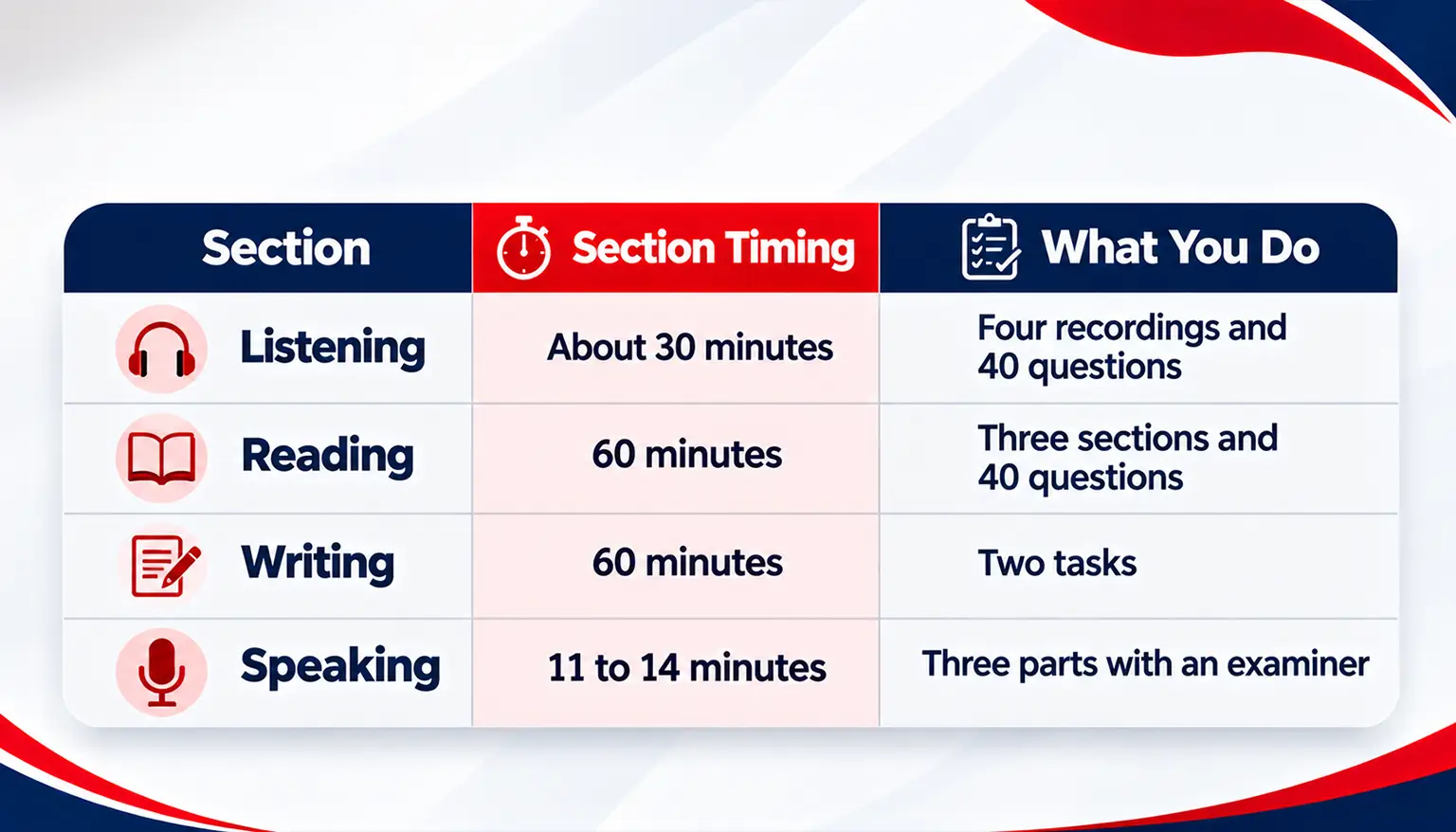
This breakdown follows the official IELTS guidelines and the British Council IELTS format page.
What Changed in 2026
In March 2026, the IELTS partners announced that paper-based IELTS would be phased out from mid-2026. The transition is taking place at different times across markets. Candidates will generally take Listening, Reading and Writing on a computer, although a Writing on Paper option is being introduced in selected markets.
Because the switch happened at different times in different countries, you should always check the options at your own test centre before you book.
Computer-delivered IELTS is now the standard choice, and the IELTS computer based test format works like this.
- For standard IELTS on computer, you type your Listening, Reading and Writing answers on screen at an official test centre.
- Your Speaking test still happens live with a certified IELTS examiner.
- Results usually arrive within 1 to 5 days after your test.
- If you are eligible, you may be able to use IELTS One Skill Retake for one section.
In selected markets, IELTS on computer also offers a Writing on Paper option. You complete Listening and Reading on a computer, handwrite your Writing answers on official answer sheets, and take Speaking with an examiner. However, this option is not available for IELTS for UKVI.
If you already have a paper-based result, IELTS recommends that results be considered valid for two years from the test date. Organisations may set their own requirements for accepting older results.
If you want an IELTS test format PDF, it is safest to use official material only. The British Council offers a free IELTS quick guide to download, and ielts.org has sample test questions. However, be careful with unofficial PDFs online, because some may still show the old paper timing.
Types of IELTS
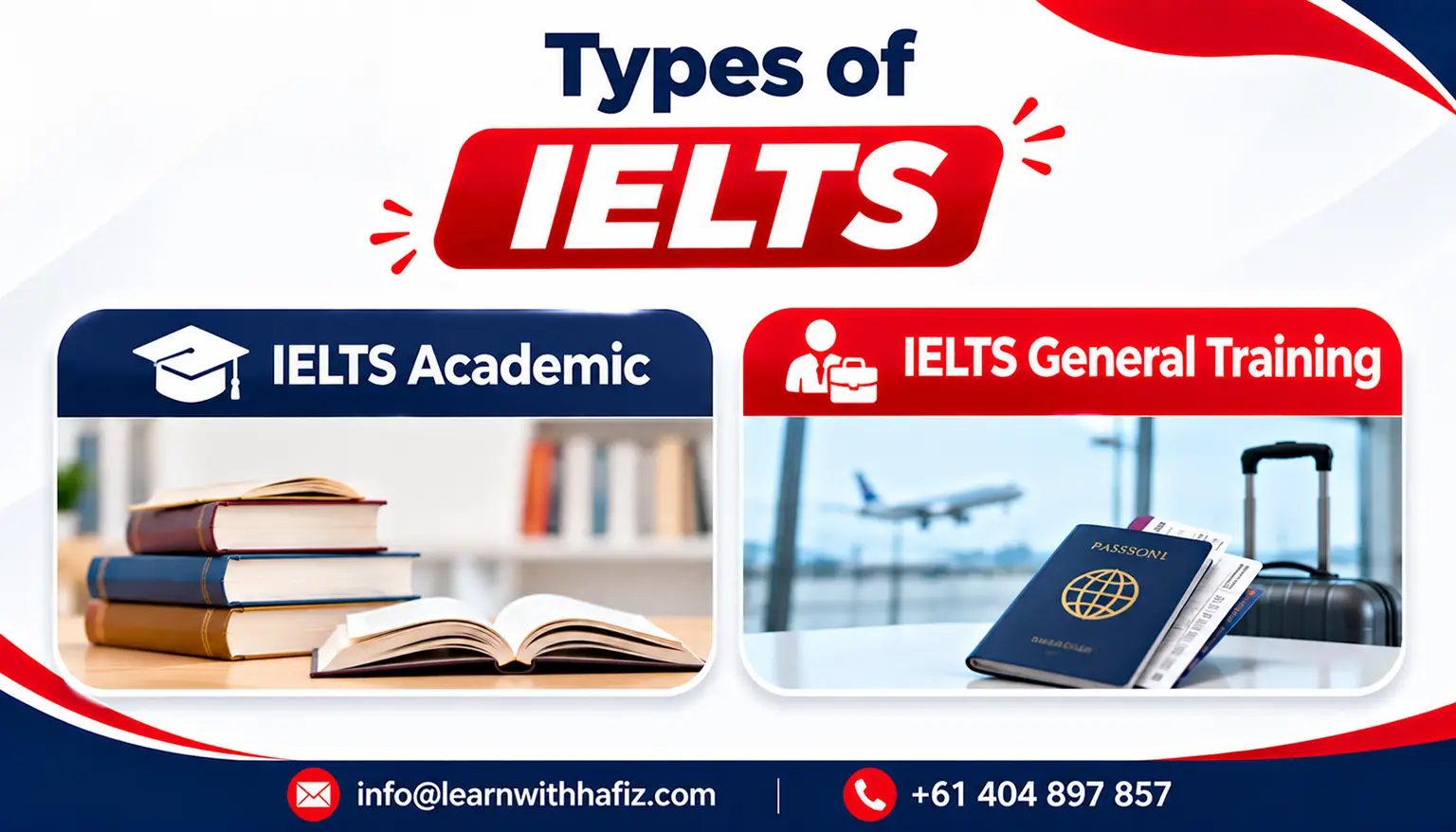
Before you start preparing, you need to pick the right test type for your goal.
1. IELTS Academic
The IELTS academic test format suits people who want to study at undergraduate or postgraduate level. It also suits professionals who need registration in an English speaking country, such as doctors and nurses.
Academic IELTS uses texts from books, journals and newspapers, and Writing Task 1 asks you to describe a graph, table or diagram.
For example, a master’s applicant in Melbourne will usually need Academic IELTS. If your goal is a study visa, read our guide on the IELTS requirement for Australian student visa as part of your student visa preparation.
2. General Training IELTS
IELTS General Training is commonly used by people applying for migration pathways in countries such as Australia, Canada and New Zealand. For UK immigration, applicants may need an approved IELTS for UKVI test, depending on their visa category and English-language requirements. It also suits people who want to train or study below degree level.
General IELTS uses everyday texts such as notices and workplace documents, and Writing Task 1 asks you to write a letter.
For example, many people applying through skilled migration pathways take General Training. However, you should always confirm which test your visa authority, employer or institution actually accepts.
Sections of the IELTS Test
1. Listening Section
The IELTS listening test format has four parts, and each part contains 10 questions. Parts 1 and 2 cover everyday social situations, such as a conversation about travel arrangements. Then Parts 3 and 4 move to education and training, such as a short lecture.
You hear each recording only once, and the speakers use different accents, including British, Australian, New Zealand and North American. Because the questions follow the order of the recording, you can track your place as you listen.
Common question types include the following.
- Multiple choice
- Matching
- Plan, map or diagram labelling
- Form, note, table or flow chart completion
- Sentence completion
- Short answer questions
On the computer test, you type your answers while the recording plays. The recording includes pauses that allow you to read questions and enter answers. At the end of the test, you receive 2 minutes to check your answers. There is no additional 10-minute answer-transfer period.
Word limits matter here too. For example, if the instruction says “NO MORE THAN TWO WORDS AND/OR A NUMBER,” three words will cost you the mark. Spelling also counts, so read our tips and tricks for IELTS Listening for more help.
2. Reading Section
The IELTS reading test format gives you 60 minutes to answer 40 questions across three sections. On IELTS on computer, that hour includes entering your answers, because there is no extra transfer period.
In Academic Reading, you work through three long passages that range from factual to analytical writing. Some passages may include diagrams, graphs or illustrations. Academic Reading passages may contain specialised or technical vocabulary. You should use the surrounding context to understand unfamiliar words.
In contrast, the format of general IELTS test Reading starts with short everyday and workplace texts. After that, the final section gives you one longer text on a general topic.
Popular question types include True/False/Not Given, matching headings, summary completion and multiple choice. Each correct answer earns one mark, and the test converts your score out of 40 into a band.
A common trap looks like this. A passage says a library opened “in the 1990s,” but the statement says it opened “in 1995.” The correct answer is Not Given, because the passage never mentions the exact year. You can learn more in our IELTS Reading guide.
3. Writing Section
The IELTS writing test format gives you two tasks, and you must complete both within 60 minutes.
- Task 1 needs at least 150 words in about 20 minutes. Academic candidates describe a graph, table, chart or diagram, while General Training candidates write a letter.
- Task 2 needs at least 250 words in about 40 minutes. In this task, you discuss a point of view, an argument or a problem.
Task 2 counts twice as much as Task 1 toward your Writing score. Therefore, spending 30 minutes on Task 1 is a costly mistake.
Examiners use four criteria, which are task achievement or task response, coherence and cohesion, lexical resource, and grammatical range and accuracy.
You must write in full sentences rather than notes or bullet points. Additionally, you lose marks if your answer goes off topic or copies text from somewhere else. Our post on IELTS Writing mistakes covers the most common errors.
4. Speaking Section
At a test centre, the IELTS speaking test format is generally a face to face interview with a certified examiner. If you take IELTS Academic Online, the Speaking test happens through a video call with an examiner. It lasts 11 to 14 minutes, and the examiner records the whole conversation.
- Part 1 lasts 4 to 5 minutes. The examiner asks about familiar topics like your home, work, studies or interests.
- Part 2 lasts 3 to 4 minutes. You get a task card and one minute to prepare, and then you speak for up to 2 minutes.
- Part 3 lasts 4 to 5 minutes. Here you discuss deeper and more general ideas linked to your Part 2 topic.
The examiner scores your fluency and coherence, lexical resource, grammatical range and accuracy, and pronunciation. However, you do not need a native accent to score well, just clear speech that is easy to follow.
Our IELTS Speaking guide has more ideas.
How Score Calculation and Band Descriptors Work
Your IELTS band score for each skill sits on a scale from 0 to 9. Your overall band is the average of all four skills, rounded to the nearest half or whole band.
An average ending in .25 rounds up to the next half band. Similarly, an average ending in .75 rounds up to the next whole band. The British Council uses this example to explain the rule.
- Listening 6.5
- Reading 6.5
- Writing 5.0
- Speaking 7.0
- The average is 6.25, so the overall band is 6.5
Examiners mark Writing and Speaking with public band descriptors, which you can read on the British Council band descriptors page. They show you exactly what a higher band requires.
If you miss your target in one skill, IELTS One Skill Retake may help, but only if you meet the eligibility rules. You need an original computer-delivered test, and you must retake the skill within 60 days in the same delivery mode. Availability also depends on your test centre. Before you book, check that your university or visa authority accepts One Skill Retake results.
Test-Day Procedures and the Exam Booking Process
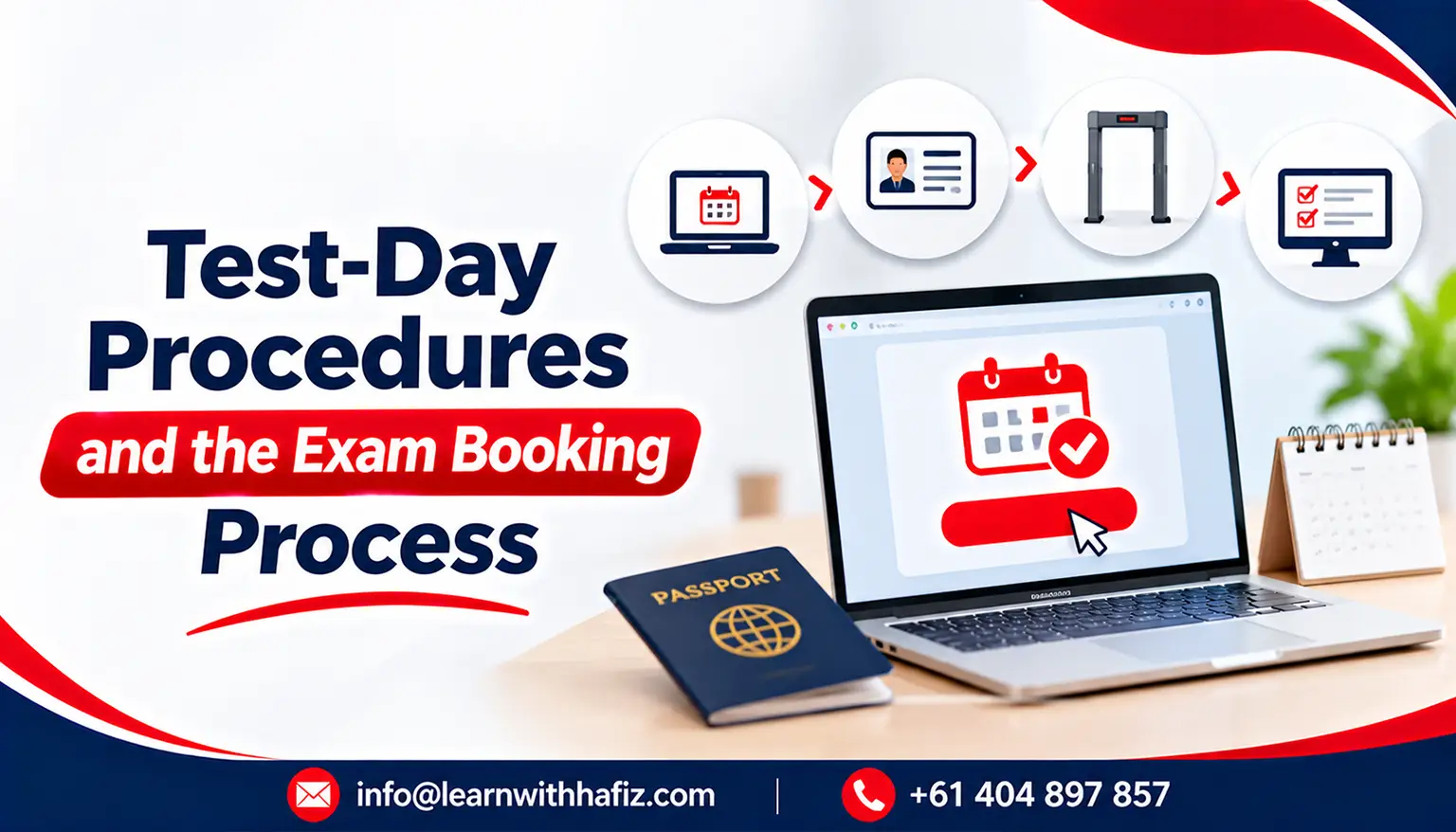
The exam booking process is fairly simple. You usually book through British Council IELTS or IDP IELTS, and then you choose your test type, delivery option, date and centre. Make sure you bring the same ID document on test day that you used to book.
On test day, arrive early so you have enough time for identity checks. You will generally need to leave your phone and other belongings in a designated storage area. Follow your centre’s instructions and check your booking confirmation early, which also helps with exam confidence building.
Preparation Strategies
These practical preparation methods work for most students, whatever their current level of English.
1. Understand the Test Format
Learn the timing and tasks in every section, then try one official sample test so nothing surprises you on test day.
2. Practice Regularly
Short daily practice usually works better than one long weekend session, such as one Reading passage and one Listening part each day.
3. Improve Your English Skills
Test tricks only go so far, so build your grammar and vocabulary through daily English reading and podcasts.
4. Listening Skills
Listen to different accents through news and lectures, and practise writing answers while the audio keeps playing.
5. Reading Skills
Practise skimming for main ideas and scanning for names and numbers. Also, read the questions first so you know what to find.
6. Writing Skills
Write one Task 1 and one Task 2 answer each week, then ask a teacher to check them against the band descriptors.
7. Speaking Skills
Record yourself answering Part 2 cards for two full minutes, then listen back for long pauses and repeated words.
8. Time Management
Use a timer every time you practise, such as 20 minutes for Task 1 and 40 for Task 2.
9. Take Mock Tests
Full mock exams show how you perform under real time limits, so take one every week or two and compare results.
If you struggle with taking notes in Listening, organising your essays or speaking for two full minutes, you do not have to work it out alone. Get IELTS Preparation Support from Learn With Hafiz through guided lessons and feedback on your Writing and Speaking.
Practice Tests and Your Score Improvement Roadmap
Here is a simple score improvement roadmap. It is hypothetical, so adjust it to your level and test date.
- Week 1. Take a full practice test under timed conditions and record your band for each skill.
- Weeks 2 to 3. Focus on your weakest skill first. For example, if Writing is 5.5, write two essays each week and get feedback.
- Weeks 4 to 5. Add timed section practice for all four skills.
- Week 6. Take another full mock test and compare it with your first result.
Now picture a hypothetical student called Sara, who scores Listening 7.0, Reading 6.5, Writing 5.5 and Speaking 6.5. Instead of practising everything equally, she spends most of her time on Writing Task 2. This is one of the most useful high-band strategies, because it targets the biggest gap first.
Free practice tests are on the British Council IELTS website, and IDP IELTS offers preparation material too.
Practice with expert feedback usually works faster than practice alone. Book a Free Trial Class with Learn With Hafiz to try mock tests and see where you lose marks. If you already have a score, try our free scorecard analysis as well.
Common Concerns Before the IELTS Test
Many students worry that the computer test is harder. However, IDP states that the content, question types and marking stay the same, so you mainly need typing practice.
Some students also believe General Training is easier, but Listening and Speaking are identical in both tests. So choose the test your goal requires.
Conclusion
The IELTS test format feels much easier once you know the modules, timing, scoring rules and 2026 changes. Your next step is to take one practice test, find your weakest skill and build your plan around it.
When you are ready to prepare with a clear plan, Learn With Hafiz offers IELTS coaching for Academic, General Training and UKVI, with mock tests and feedback on your Writing and Speaking. Book a Free Trial Class or call +61 404 897 857 today to discuss your target band and test date.
Frequently Asked Questions
Q. Can I ask for additional scratch paper if I run out during the IELTS exam?
Rules depend on your test mode and centre. On the computer test you can make notes on screen, and you can always raise your hand to ask the invigilator what is allowed.
Q. Can I use abbreviations in my writing for the IELTS exam?
It is better to avoid abbreviations in the Writing test. Spell words out in full, so your answer stays clear and formal.
Q. Does the IELTS test have an age restriction?
IELTS has no official upper age limit for test takers. However, the IELTS partners do not recommend the test for people under 16.
Q. What is the most effective time management method for the IELTS reading test?
Plan time for each section and save more for the final passage, which is usually the hardest. Also, skip hard questions and return to them later.
Q. What is the validity period of the IELTS test certificate?
IELTS recommends that results be considered valid for two years from the test date. However, each organisation sets its own rules, so check with them directly.