

A lot of students understand the passages in the IELTS reading test and still run out of time. Others finish early but lose marks on tricky question types like True False Not Given. Either way, the result feels unfair, because you know your English is better than your score.
That gap matters, because Reading counts for a quarter of your overall band, and many universities and visa routes also set a minimum Reading score.
The good news is that reading is a skill you can train. This guide explains the current test format, how the IELTS reading band score works and the strategies that actually help. You’ll also find a practice plan and answers to common questions.
Understanding the format is the first step, but timed practice with feedback is what moves your score. If you’d like a trainer to look at where you’re losing marks, you can Book a Free Trial Class with Learn with Hafiz and get a clear starting point.
Significance of IELTS Reading
The IELTS reading section checks how well you understand written English in real situations. It tests whether you can find main ideas, spot details, follow an argument and understand a writer’s opinion.
The test also checks whether you can read for gist, follow how ideas connect and work out meaning that isn’t stated directly. These skills matter beyond the exam, too. At university, you’ll read journal articles and long reports. At work, you’ll follow handbooks, emails and official documents.
Reading also carries real weight in your results. Your overall IELTS band is the average of Listening, Reading, Writing and Speaking, so Reading makes up a quarter of it.
However, many organisations look at each skill separately. Universities often ask for a minimum Reading band, and some visa routes do too.
Here’s a hypothetical example. Ali needs 6.5 overall with at least 6.0 in each skill. He scores 7.0 overall but 5.5 in Reading, so he still falls short.
That’s why Reading matters so much for student visa preparation and many migration pathways. For example, the UK generally asks new Skilled Worker applicants for B2 English, which means at least 5.5 in each skill in IELTS for UKVI. Some people who held a Skilled Worker visa before 8 January 2026 can still meet the B1 requirement when extending or updating their visa, under the transitional rules.
IELTS Reading Test Format
The IELTS reading test lasts 60 minutes and has 40 questions across three sections. Academic Reading texts total about 2,150 to 2,750 words, so you need to read quickly and accurately.
The texts get harder as you move through the test. So it often makes sense to finish Section 1 quickly and save time for the later sections.
Academic Reading
Academic reading has three long texts. They come from books, journals, magazines and newspapers, and they suit people heading into undergraduate or postgraduate study, or seeking professional registration.
The texts can be descriptive, factual or analytical. Many include research findings and arguments, so you’ll need to follow both facts and the writer’s attitude. If a passage contains technical vocabulary, a simple dictionary definition is provided to explain the terms.
General Reading
General reading, officially called General Training, uses everyday texts you’d meet in an English-speaking country. The three sections look like this.
- Section 1. Two or three short texts, or several shorter ones, on everyday topics such as notices, advertisements and timetables.
- Section 2. Two texts about work, like job descriptions, contracts or staff policies.
- Section 3. One longer text on a general topic, taken from a book, magazine or newspaper.
Taking the Reading Test on Computer
From mid-2026, IELTS is no longer offered as a fully paper-based test. Listening and Reading are delivered on computer, although candidates in selected markets can choose to handwrite their Writing answers through the Writing on Paper option. The exact switchover date varies by country.
In Reading, you see the passages on screen and type or select your answers directly. So there’s no answer sheet and no separate transfer time, but you still need to watch the clock closely.
Because Reading is always on computer now, practise reading long texts on a screen, not just on paper.
IELTS Reading Question Types
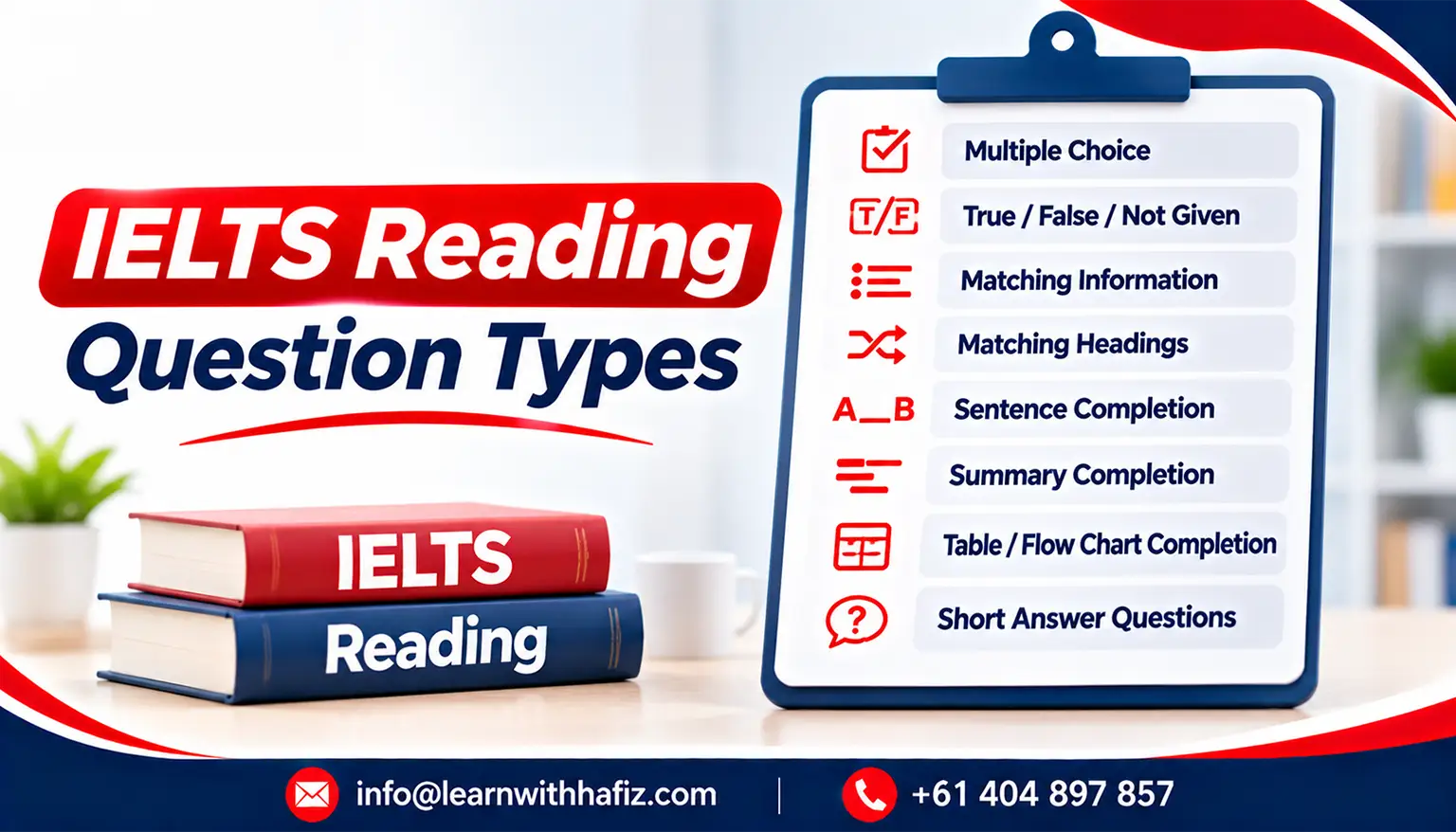
Academic and General Training Reading use the same main IELTS reading question types. Only the texts and their contexts change. Here are the main ones.
- Multiple choice. Choose the correct answer from several options.
- True False Not Given. Decide whether statements match the facts in the text.
- Yes No Not Given. Decide whether statements match the writer’s views or claims.
- Matching headings. Match a heading to each paragraph or section.
- Matching information. Find which paragraph contains specific information.
- Matching features. Match statements to names, dates or categories.
- Matching sentence endings. Complete sentences using the correct endings.
- Sentence completion. Fill gaps using words from the text.
- Summary, note, table and flow-chart completion. Fill gaps in a summary or diagram.
- Diagram label completion. Label parts of a diagram.
- Short-answer questions. Answer using words from the passage.
True False Not Given often causes confusion. “False” means the statement contradicts the information in the text. “Not Given” means the text neither confirms nor contradicts the statement.
For example, imagine a text says a museum opens at 9am. A statement saying it opens at 10am is False. But a statement saying it’s the city’s oldest museum is Not Given if the text never mentions that.
How to Approach the Trickiest Question Types
Matching headings works best if you read the headings first, then skim each paragraph for its main idea. Ignore small details, because a heading sums up the whole paragraph rather than one sentence in it.
Sentence completion asks for words from the text. So find the right part of the passage, check the word limit and copy the words exactly as they appear.
Multiple choice often includes options that use words from the text but change the meaning. Therefore, read every option carefully and rule out the ones that don’t fully match.
Questions usually follow the order of the text, though matching headings and some matching tasks don’t. Knowing this helps you find answers faster.
How the IELTS Reading Band Score Works
Each correct answer earns one mark, and there’s no penalty for wrong answers. So never leave a question blank, even if you have to guess.
Your raw score out of 40 is then converted to an IELTS Reading band score from 1 to 9. The exact table varies slightly between test versions, so the figures below are approximate.
- Academic reading. Around 30 correct answers usually gives a Band 7.
- General reading. Around 35 correct answers usually gives a Band 7.
General Training needs more correct answers for the same band because its texts are generally less complex. Therefore, don’t compare Academic and General Scores directly.
Spelling matters too. If you spell an answer wrongly or ignore the word limit, you won’t get the mark. For example, if the instructions say “NO MORE THAN TWO WORDS,” a three-word answer won’t count.
Unlike Writing and Speaking, Reading doesn’t use band descriptors. Your score comes only from the number of correct answers.
Many lost marks come from a few fixable habits, like misreading instructions or spending too long on one passage. For a practical plan built around your weakest question types, you can Try a Free IELTS Reading Lesson with Learn with Hafiz and see what to fix first.
IELTS Reading Improvement Techniques
These IELTS reading improvement tips build on the original techniques, updated with what works for today’s test.
Plan Your Reading Time
Make reading a daily habit, even for 20 minutes. Pick a regular time and stick to it, whether that’s on your commute or before bed.
In the test itself, time management is just as important. IDP suggests spending no more than 20 minutes on each section. If a question takes too long, guess, mark it and move on.
Because the sections get harder, many students aim for around 15 to 17 minutes on Section 1. That leaves a little extra time for Sections 2 and 3, where the texts are longer and the questions are harder.
Read a Wide Range of Sources
Read news websites, magazines, science articles and opinion pieces. This builds reading comprehension and exposes you to different writing styles.
For General Training, also read everyday texts like notices, workplace policies and advertisements. These look a lot like the texts in Sections 1 and 2.
Make Notes
As you read, note new words, key ideas and phrases that express opinions. This supports vocabulary building and helps you remember language later.
Try grouping words by topic, like environment, health or technology. Also note synonyms, because questions rarely use the exact words from the passage. For example, the text might say “decline” while the question says “fall.”
Learn How to Scan and Skim
Skimming techniques help you get the main idea quickly. Read the title, the first and last paragraphs and the first line of each paragraph.
Scanning techniques help you find specific details, like names, dates or numbers. Instead of reading every word, move your eyes quickly to find the keyword you need.
For example, if a question asks when a bridge was built, scan for years rather than reading the whole passage again.
Engage with the Text
Don’t just read passively. Instead, ask yourself what the writer is arguing and why, and predict what comes next.
This active approach improves reading accuracy, especially for questions about the writer’s views. It also helps you remember what you’ve read.
Build Your Reading Speed
Reading speed enhancement takes steady practice, not tricks. Start by timing how long you take to read a 700-word article, then try to beat that time each week without losing understanding.
Also, avoid reading word by word or saying words in your head. Try to read in small groups of words instead, because this helps your eyes move faster.
However, speed only helps if you still understand the text. If your accuracy drops, slow down a little and build up again.
Use Practice Tests the Right Way
An IELTS reading practice test shows you the real format and timing. Use an IELTS academic reading practice test or an IELTS general reading practice test, depending on which version you’ll sit.
After each one, check your answers carefully. An IELTS reading practice test with answers lets you see exactly why each answer is right or wrong. That review is where most of your progress happens.
Here’s a hypothetical example. Maria scores 26 out of 40 on a practice test. When she reviews it, she finds eight of her mistakes are True False Not Given questions. So she spends the next week practising only that question type before her next mock test.
Common Reading Mistakes to Avoid
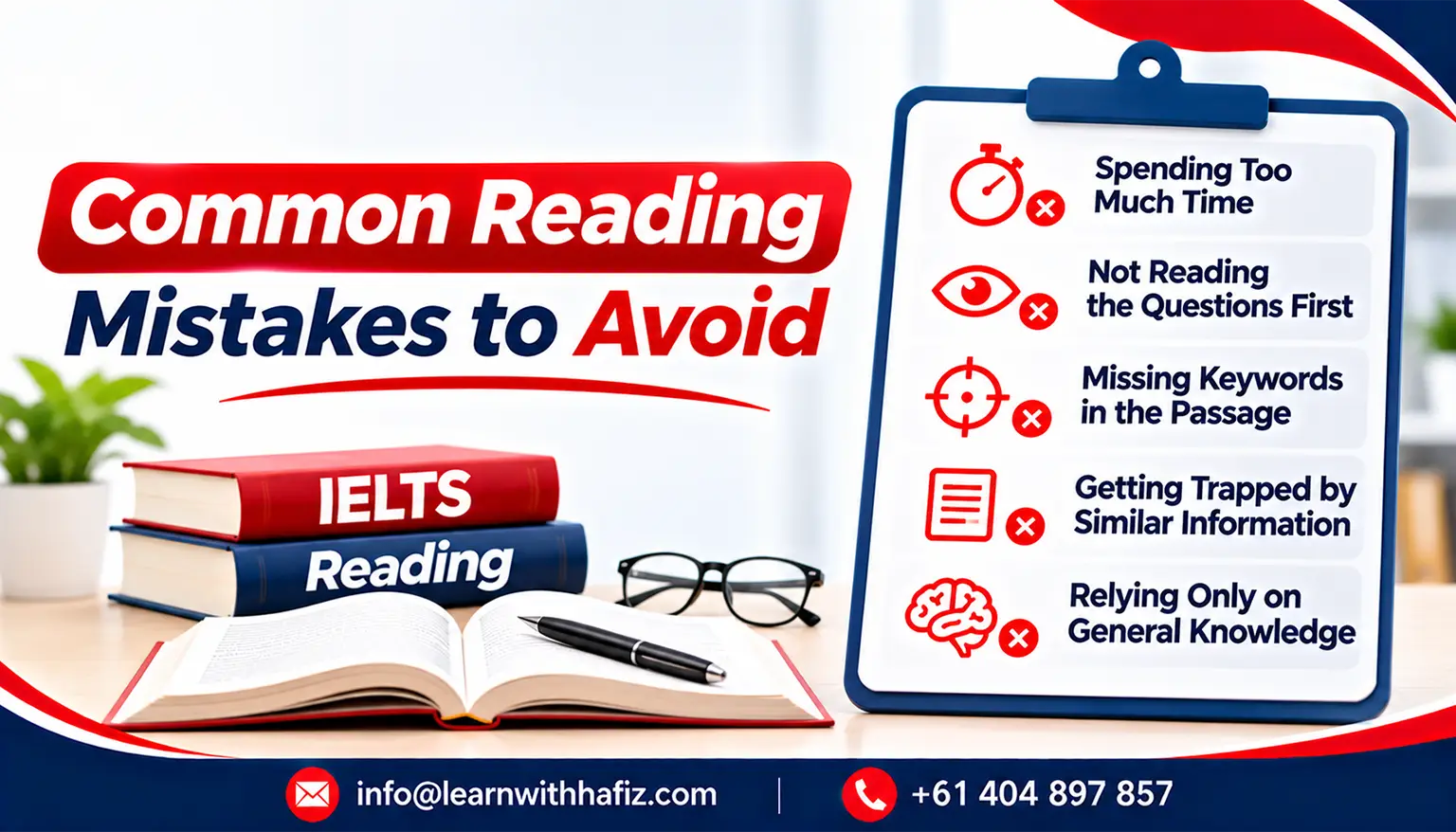
Knowing the common reading mistakes can save you easy marks. For instance, if the limit is ONE WORD ONLY and you write “the solar panels,” your answer is wrong even though you found the right idea. Watch out for these.
- Ignoring word limits. Extra words make a correct answer wrong.
- Spelling errors. A misspelled answer gets no mark.
- Confusing False and Not Given. Check whether the text contradicts the statement or does not provide enough information to confirm or contradict it.
- Matching words instead of meaning. The right answer often uses different words from the question.
- Spending too long on one question. Guess, flag it and come back later.
- Leaving answer boxes empty. Use the last minute to check that every question has an answer.
These question-solving methods sound simple, but they protect your score. Score improvement strategies usually come from fixing small habits rather than learning big tricks.
A Four-Week Reading Practice Plan
Here’s a simple high-band roadmap you can adapt to your level. It’s a guide, not a promise of a particular band.
- Week 1, format and question types. Learn each question type and try one passage a day without a timer.
- Week 2, skimming and scanning. Practise finding main ideas and details quickly. Start timing each passage.
- Week 3, weak question types. Focus on the types you get wrong most, such as matching headings or True False Not Given.
- Week 4, full mock tests. Take at least two full IELTS reading mock tests under real timing.
This mock test preparation gives you a real exam simulation. It also shows whether your reading speed enhancement is holding up under pressure.
Exam Confidence Building for Test Day
Nerves can slow your reading down, even when you know the material. Exam confidence building starts long before test day, through regular timed practice.
On the day, read the instructions for every question set carefully. Then highlight keywords in the questions before you look for answers in the passage.
If you hit a difficult passage, don’t panic, because every question is worth the same mark. Answer the easier questions first, guess the rest and keep moving. A calm, steady pace usually beats rushing.
Where to Find Practice Resources
Start with official IELTS guidelines and materials. The official IELTS website, British Council and IDP all offer free IELTS reading test samples and practice papers.
These practice resources match the real test format closely. Cambridge also publishes official IELTS practice books with full tests and answer keys.
Third-party materials can help too, but their difficulty and question style may vary. So use them for extra practice rather than as your main guide to the real test.
Common Questions about the IELTS Reading Test
Is there extra time to transfer answers?
No. Because Reading is now taken on computer, you enter your answers directly on screen within the 60 minutes. There’s no separate transfer time.
Do I lose marks for wrong answers?
No. Wrong answers simply score zero, so always attempt every question.
Is General Training Reading easier than Academic?
The texts are generally more every day in style. However, you need more correct answers for the same band, so it isn’t automatically easier to score well.
Can I retake only the Reading test?
In some cases, yes. IELTS One Skill Retake lets you resit one skill within 60 days of your original full IELTS on computer test, if you took it at a participating centre. You can only use it once per original test, and not every organisation accepts the results, so check with yours first.
Do I need to read the whole passage?
Not in detail. Skim it first for the main idea, then scan for specific answers. Reading every word carefully usually takes too long.
How long should I spend on each question?
You have 60 minutes for 40 questions, which works out to about a minute and a half each. In practice, spend less time on Section 1 so you have more for the harder sections.
Conclusion
The IELTS reading test rewards accuracy, smart time management and familiarity with the question types. Once you understand the format, your practice becomes far more focused.
Use IELTS reading strategies like skimming and scanning, read widely and review every practice test carefully. Additionally, track which question types cost you the most marks. Steady practice is also the best way to build exam confidence.
With the right practice and feedback, you can raise your Reading band step by step. Book Your Free Trial Class with Learn with Hafiz today, or call +61 404 897 857 to plan your reading preparation around your target score.