


Preparing for the NAATI CCL test takes time, practice and a solid grasp of both languages. Even so, after weeks of study you can still blank on a word, lose your place in a sentence, or stumble over a short segment. People usually call this avoiding brain freeze in the NAATI CCL.
The good news is that you can build habits to handle these moments. You can’t promise yourself you’ll never feel nervous, but you can get better at staying calm when something goes wrong. This guide explains why brain freeze happens, how to manage stress, and how to improve your interpreting practice, with NAATI CCL test anxiety tips you can use on test day. Learn With Hafiz recommends focusing on steady preparation, realistic practice, and techniques you can actually use during the test.
Why does our brain freeze?
Brain freeze is an informal phrase for those moments when you can’t pull up information, hold your focus, or find the right words. It isn’t a medical diagnosis, and it doesn’t mean you’ve forgotten everything you studied.
Under stress, it’s easy to think more about making mistakes than about the conversation in front of you. You might start worrying about your score, the next segment, or what happens if a word won’t come. Those thoughts take up space your attention needs.
Why does this happen during the NAATI CCL test?
The test asks you to listen closely and carry meaning between English and another language. You have to understand the message, hold on to the important details, and say it naturally in the other language.
According to the official NAATI CCL test information, the test has two prerecorded dialogues. Each one is about 300 words, split into short segments of 35 words or fewer.
After each segment a chime sounds, and that’s your cue to start interpreting. NAATI expects you to begin within five seconds of the chime, so you don’t have long to gather your thoughts.
Common reasons for brain freeze
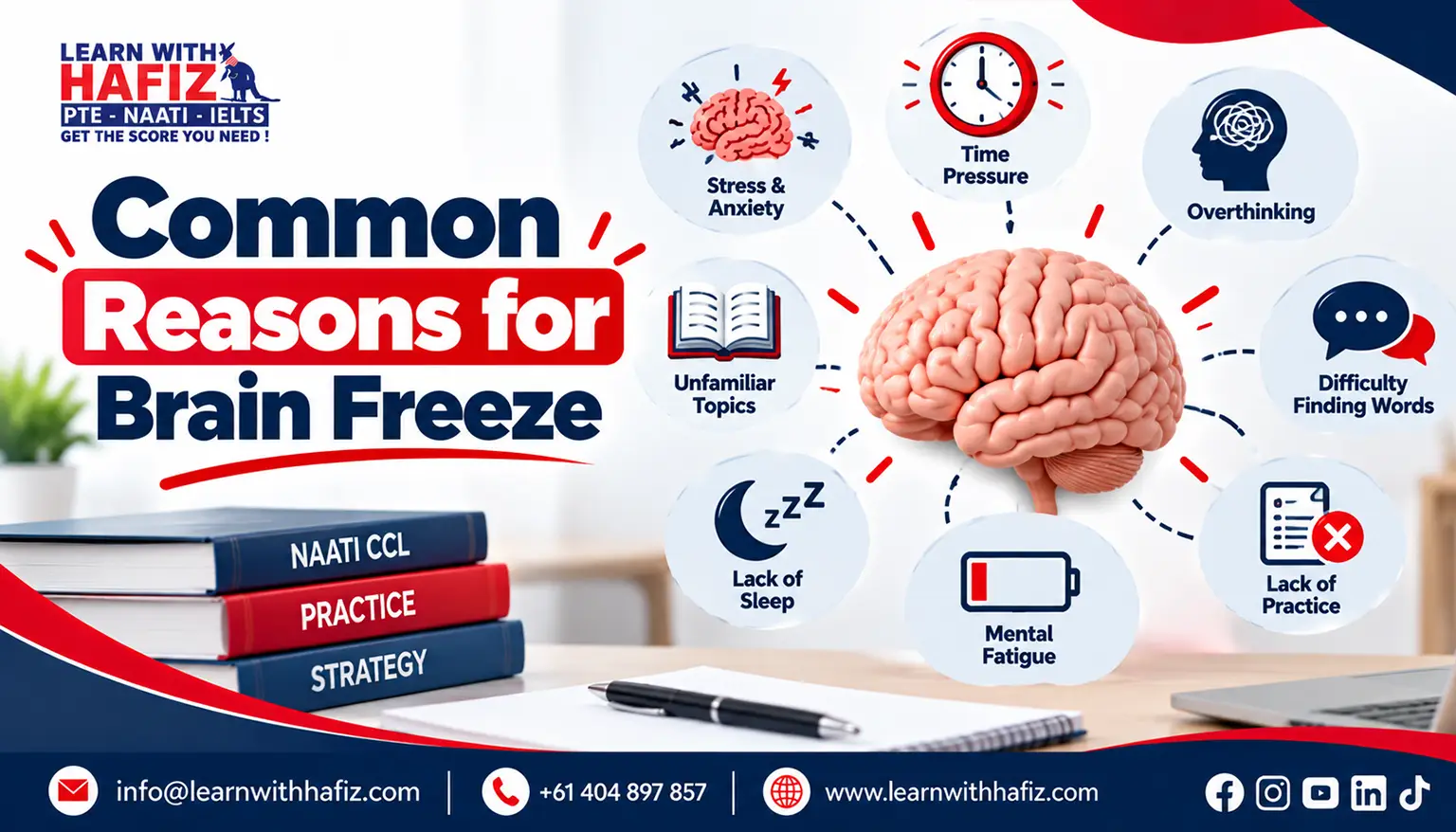
Several things can trigger a brain freeze during interpretation segment work.
You might be worrying about a mistake and replaying your last answer instead of listening. Unfamiliar vocabulary, tricky sentence structures, numbers, or details you didn’t note down can also throw you.
Tiredness plays a part too. Poor sleep and last-minute cramming leave you less sharp, so your preparation needs regular practice, proper rest and realistic expectations.
Things to do to avoid brain freeze in the NAATI CCL test
The best approach is to prepare for the situations that usually make you lose focus. Motivation alone won’t carry you, so build a routine that helps you listen, take notes, interpret, and recover after a slip.
These strategies can help you feel more confident, but they won’t promise you’ll never feel anxious.
1. Study effectively
Studying effectively means practising the skills you’ll use in the test, not trying to memorise huge amounts of information. Vocabulary knowledge matters, but you must also understand words in context and use them naturally.
Start by identifying your weaker areas, because you might struggle with medical terminology, financial discussions, formal expressions, or numbers. Once you identify a weakness, practise it in short dialogues and complete sentences.
How effective preparation can prevent brain freeze
The following methods can help.
- Review vocabulary by topic and practise translating complete sentences.
- Record difficult expressions and revisit them throughout the week.
- Practise numbers, dates, amounts, names, and other details that require accuracy.
- Compare your interpretation with the original recording and identify missing information.
- Practise explaining the same idea using different natural expressions.
These NAATI CCL mental preparation strategies work best when you use them consistently. Learn With Hafiz can help you organise your preparation around the areas that need improvement.
2. Put in as much practice as you can
Practice helps you become familiar with the listening and interpreting process. However, the quality of your practice matters more than the number of hours you spend repeating the same easy exercises.
Begin with short recordings. First, listen to a segment, make brief notes, and interpret it into the other language. Once you feel comfortable with shorter passages, gradually practise complete dialogues.
A mock test should reproduce the main demands of the real assessment. Use a recording, allow yourself to hear each segment, and begin interpreting when the chime sounds.
Why mock tests can reduce exam fear
Overcoming fear in NAATI CCL exam preparation takes repeated exposure to the real task. A realistic practice session helps you learn what the test feels like. You can discover whether you struggle more with listening, note-taking, vocabulary retrieval, or speaking under time pressure.
The phrase mock test practice reduces exam fear describes a useful preparation principle, although practice does not remove anxiety for everyone. Repeated exposure to a familiar task can help you feel more prepared for its demands.
Try this routine during practice.
- Complete a short dialogue without stopping unnecessarily.
- Record your interpretation so you can review it afterwards.
- Compare your version with the original meaning.
- Note any omissions, additions, grammar problems, or long pauses.
- Repeat the exercise while focusing on the weaknesses you identified.
You can also use NAATI’s official NAATI CCL practice test to become familiar with the testing platform. However, the free online practice test includes only one dialogue and does not use the proctoring service, so it cannot reproduce a full test. NAATI also provides downloadable practice materials in different languages. Check the official CCL practice materials page for available resources.
Practice under realistic conditions
This realistic exam simulation stress relief strategy helps you become more familiar with the process. It can also reveal practical problems, such as speaking too quietly, writing notes too slowly, or spending too long correcting yourself.
3. Get enough sleep
Sleep should be part of your preparation, not something you sacrifice to study more vocabulary. When you feel tired, it can become harder to concentrate, organise your thoughts, and respond patiently to difficult material.
How to prepare your routine before test day
Try to keep a consistent sleep schedule during the final days of preparation. Also finish your most demanding practice early enough to relax before bed.
Make sure you know when your test is scheduled. NAATI lists test times in Australian Eastern Time, so check the time carefully if you are sitting the test from another country.
4. Develop your ability to relax
Learning to relax does not mean trying to eliminate every nervous feeling. Instead, it means having a simple method to manage tension before it interferes with your concentration.
Try a simple breathing exercise
The NHS breathing exercise guide recommends gentle, regular breathing for stress and anxiety.
You can try the following routine before a practice session.
Sit comfortably with both feet resting on the floor. Breathe in gently through your nose. Some people find it helps to count from 1 to 5, but you may not reach 5 at first. Then breathe out gently through your mouth without holding your breath, counting from 1 to 5 again if that helps. Continue for 3 to 5 minutes, keeping your breathing gentle and comfortable.
This deep breathing exam stress technique may help you feel calmer when you practise it regularly. It is a general relaxation strategy, not a way to guarantee better test scores.
Mental rehearsal before the exam
Mental rehearsal means imagining yourself completing a task and responding to common difficulties. Before the test, picture yourself listening to a segment, recording a few useful notes, and interpreting the message clearly.
Mental rehearsal before NAATI exam day can help you develop a practical response to uncertainty. You are preparing yourself to follow a familiar process even when the material is challenging.
Think of this as a positive mindset interpretation performance habit. It does not mean ignoring mistakes. It means treating mistakes as information you can learn from rather than proof that you cannot pass.
5. Improve your note-taking and memory
NAATI CCL note-taking techniques are useful because they help you retain important details while listening. However, writing too much can distract you from the recording and leave you with incomplete information.
Your notes should support your memory rather than replace it. Therefore, focus on key ideas, relationships, numbers, names, dates, and other details that matter to the meaning.
Note-taking to avoid memory lapse
Your approach to note taking to avoid memory lapse should be simple enough to use quickly. You do not need to write every word you hear.
Practise writing notes while listening to short recordings. Afterwards, check whether your notes helped you retain the main meaning and important details.
Important test rule. NAATI permits handwritten notes made during the test using a pen and loose sheets of paper. However, candidates cannot bring existing notes into the test, and they cannot use a device to record or translate test materials. Read the latest official candidate instructions before your appointment.
Segment recall under pressure technique
The segment recall under pressure technique involves active listening focus during CCL test dialogues, which means listening for meaning rather than trying to memorise every individual word.
When you hear a segment, identify the speaker’s main point, supporting details, and any important relationships. For example, distinguish between a person who has already paid a fee and someone who still needs to pay it.
6. Stay calm when you lose words mid dialogue
Learning how to stay calm in NAATI CCL practice sessions makes difficult moments easier to handle. Even well-prepared candidates may encounter a segment containing unfamiliar vocabulary or a complicated sentence. The important thing is to avoid letting one difficult moment affect the rest of your performance.
If you are losing words mid dialogue NAATI still expects an accurate message, so return your attention to the meaning you understood. Think about the speaker’s message and choose an accurate expression that communicates it naturally.
For example, suppose you cannot remember the exact translation of a phrase about a payment arrangement. If you understand that the speaker wants to divide a payment into smaller instalments, communicate that meaning clearly in your target language.
What if you cannot remember a segment?
NAATI allows you to repeat one segment per dialogue without a penalty. If you need to use this option, follow the procedure in the official candidate instructions. Repeating more than one segment per dialogue results in a deduction.
You should also know the rules about pauses. NAATI requires candidates to begin interpreting within five seconds of the chime, which is why pausing penalty hesitation in CCL is a real concern for candidates. Long pauses and repeated self-corrections can also make your interpretation harder to follow. If you make a small mistake, correct it when necessary and continue. Avoid repeatedly restarting the same sentence because you want every word to sound perfect.
7. Build confidence with familiar topics
The CCL test uses dialogues based on everyday situations in Australian society. Official topic examples include health, education, employment, housing, legal matters, financial matters, immigration and settlement, and consumer affairs.
You cannot know which specific dialogues will appear in your test. However, practising a broad range of relevant subjects can help you recognise common expressions and understand the context more quickly.
Familiar topics reduce anxiety NAATI candidates may feel, but this is preparation advice, not a guarantee. Familiarity can make some conversations easier to follow, but you still need to listen carefully to the actual recording.
Create a practical topic plan
Choose one topic for each practice session, then learn relevant vocabulary in both languages, listen to a short conversation, and interpret it without reading a prepared translation.
After each session, identify the expressions you could not recall quickly. Add those expressions to your revision list and practise them in new sentences.
This method shows why consistent practice builds exam confidence, because you can see how your understanding improves over time. These NAATI CCL confidence building tips work best when you track your progress.
Use self-recording to review your progress
Self-recording practice for confidence is useful when you do not have a teacher available for every session.
Record your interpretation and listen to it afterwards. Then check whether you included the key information, used natural grammar, maintained the appropriate tone, and spoke clearly enough to be understood.
Vocabulary preparation reduces brain freeze when it helps you retrieve useful expressions more easily, but vocabulary alone cannot replace listening practice and accurate interpretation.
8. Understand the scoring rules and prepare accordingly
Understanding the NAATI CCL scoring criteria can help you focus on the skills that matter. According to the official CCL test page, the test is marked out of 90 points, with each dialogue worth 45 points.
To pass, you need at least 63 points overall and at least 29 points in each dialogue. Therefore, a high score in one dialogue cannot make up for a score below 29 in the other.
NAATI uses a mark deduction method, which means examiners take marks off for errors in your interpretation.
Practise accuracy rather than perfection
You do not need to reproduce every sentence using exactly the same words. However, you must communicate the important meaning without adding, omitting, or changing information.
When reviewing your practice, ask yourself whether you preserved the speaker’s intention, numbers, names, dates, and other relevant details. Check whether your grammar or word choices changed the message.
NAATI expects candidates to interpret using direct, first-person speech. Marks may be deducted for interpreting a sentence or segment in indirect speech, and interpreting an entire dialogue in indirect speech may invalidate the test. Review NAATI’s official candidate instructions before your test.
Read the latest official instructions because test procedures and requirements can change. NAATI also makes clear that passing the CCL test is not professional interpreter or translator certification. If you are taking the test for migration purposes, confirm the relevant requirements with the Australian Department of Home Affairs or a registered migration professional.
Frequently asked questions
Can I completely prevent brain freeze during the NAATI CCL test?
No technique can guarantee that you will never experience a moment of hesitation. However, regular practice, good preparation, adequate rest, and simple relaxation methods can help you respond more effectively when you feel nervous.
What should I do if I forget a word during interpretation?
Focus on the meaning you understood and choose a natural, accurate expression in your target language. Avoid inventing information or repeatedly correcting yourself over a minor wording choice.
How can I practise managing stress during CCL interpretation?
Use realistic practice sessions, record your responses, and practise gentle breathing before you begin. These managing stress during CCL interpretation methods may help you feel more familiar with the task and more prepared to handle difficult segments.
Can Learn With Hafiz help me prepare?
Learn With Hafiz offers NAATI CCL preparation support for candidates who want to strengthen their interpreting skills. Before choosing a course, consider whether you need help with vocabulary, note-taking, accuracy, fluency, or test practice. Select preparation that addresses your actual weaknesses.
Conclusion
Brain freeze in the NAATI CCL test can feel discouraging, especially when you have spent weeks preparing. However, one difficult segment does not mean you have lost all your knowledge or cannot recover your focus.
Build a steady preparation routine, practise with realistic dialogues, improve your note-taking, and learn how to respond when you cannot recall a word immediately. Review your recordings and work on recurring weaknesses rather than chasing perfect performance in every sentence.
Learn With Hafiz can help you develop a more structured approach to your NAATI CCL preparation. Start by identifying the areas that cause you the most difficulty, then practise them regularly and measure your progress.
The aim is to enter the test with a clear plan, a realistic understanding of the rules, and the ability to focus on one segment at a time.